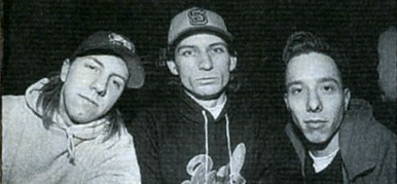
Rick Moliterno, Krt Schmidt, and Bill Nitschke started Standard Byke Company in 1991.
Rick Moliterno: I rode for Haro for about six years and it was fun as hell. After freestyle sales took a dive they got all weird and started cuting us way, way, way back. At this time (1990, 1991) riding was changing, it was going towards street and skatepark style, being more abusive on the bikes (I was breaking them every three weeks). I went to Haro and offered to redesign their bikes and be a team manager to select riders that we're of that new style at the time for them. They pretty much said you can redesign our bikes but we are not going to pay you. I told them that I did not want to ride for them anymore and that I was going to start my own thing. If they would have say yes this would be Haro today. So they said no, then I got together with Krt Schmidt, and then we talked to Bill Nitschke to see if he wanted to go in on it with us. So we started Standard in november 1991. We started getting prototypes right away. Then for production I think we got them in the end of '92. Our first production run was made by a machine shop in Davenport. They couldn't make them right so we refused them all. Those bikes that were refused are what became Basic Bikes. (...)
Krt, Th' Link Magazine, june 2008: The bikes we were riding were falling apart every month. During that time biking was going through a transition that added, “street riding” to the mix. Riding “street” was all about discovery and all that innovation was a lot harder on bikes than ever before. Riders wanted to take riding in new directions but the frames and parts were limiting creativity. I’ve heard this time referred to as the “over-built” period of biking, which is not an entirely true statement. It was the single greatest time of discovery and progression ever in our sport, which in turn changed the way that bikes were made. I had made my mind up to move to California in 1990. I was planning on turning pro the following year and I felt I had to be closer to the media. I went out there in August to find a place to live and while I was gone Rick called my house and left a message that it was imperative that I called him as soon as I got back. When I called Rick back he told me that him and Bill Nitscke were thinking about teaming up to do a bike company but he wanted me to be involved. I was so blown away that Rick wanted me as a partner that I moved to Iowa a few months later.
Krt Schmidt, krtschmidt.com, may 2008: When we first started Standard I knew what we were doing was different and I wanted that reflected in the name of the bikes themselves hence the deliberate misspelling of the word “Byke”. I also liked the juxtaposition of a name like “Standard” next to a very un-standard spelling of bike. The duality of the two really said a lot about what we were trying to do in the stagnate industry of the time.
Brian Tunney, espn.go.com, january 2009: Founded in 1991 by Rick Moliterno, Krt Schmidt and Bill Nitschke, Standard's philosophy was simple. They wanted to re-write the book on how a BMX company was run, from the bikes to the team to promotions. And they did this in a number of ways. They created a US-made line of frames, forks, handlebars and components that they stood behind with a lifetime warranty. They sponsored one of the best teams to ever grace a BMX company (the list of legends that have passed through the hallowed halls of Standard Byke Co. is ridiculous; Sandy Carson, Taj Mihelich, Jimmy Levan, Robbie, Morales, Joe Rich, Ron Kimler, Chad Degroot, Dave Freimuth, Luc-E, The Gonz, Ratboy, Paul Osicka and Corey Martinez to name but a few), and they produced more than a handful of legendary videos that showcased not only the team, but the ridiculously technical and innovative riding of both Moliterno and Schmidt. There was more as well. Standards ads and graphics helped to refine a new age of design in BMX, and on the tech side of things, Standard was moving ahead faster than any other rider-owned company, incorporating threadless headset clamp-on stem/fork combos that worked with detanglers as early as 1994. (I know that doesn't sound like a tall order these days, but back then, it was mind bottling.)
Standard Industries introduces the Lengthy and Shorty frame. These frames have thicker dropouts and are much stronger than any bike in the market.
Rick Moliterno, digbmx.com, may 2012: The Shorty and Lengthy were just our reaction to all of the change in riding going on and the regular bikes from the show era not being able to handle the new street and park riding. People seemed to agree so here we are 21 years later!
Philbert, www.radbmx.co.uk, november 2008: Generation 1 revolutionised bmx with beefy tubing, large platform, 6mm dropouts, and super strong construction. Generation 2 saw the backend tidied up with the stays being straightned out instead of toeing in toward the rear and the dropout ends were capped and became a distinctive mark on sbc frames.
BIGGER PEGS.
Bolt on Pegs. Not the kind that screwed on to your axle. These pegs were longer, thicker and stronger.
HEAT TREATED AXLE.
Standard introduced a longer and stronger heat treated cromolyn axle that could be purchased for around $12.
THICK CHAIN.
NITSCHKE OFF.
Bill Nitschke left Standard Industries in december.
Rick Moliterno: Bill was a mistake, he basically wanted to get a paycheck and draw million bucks off of the company the first day.(...) Krt and I didn't really like the fact that we were busting our asses fourteen hours a day and Bill wouldn't even show up for a week. (...) After he left we officially incorporate the company into Rampage so Rampage could financially support the company. (...)
christhejob, www.radbmx.co.uk, november 2008: nitschke left in late 92 early 93ish mostly because of financial issues, remember he had Pulse products before standard, early standard pegs were very similar to his Pulse Pegs, and the money made from those and the HT axles and Roger's Garage had to be ploughed back to get standard up and running. I think Bill wanted money out, so left and started up Indy (this was the Krt S version of events)
63.
63 is the official number of Standard Bykes. It's Rick Moleterno's lucky number because he sees it appearing everywhere so he adopted it to help represent his company.
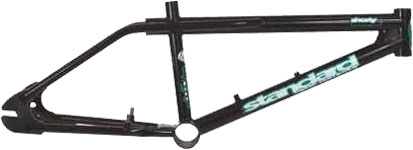
Shorty
Standard catalog: All Standard STAs, Shortys, Lenghty, and freestyle forks are guaranteed for life. No matter what happens, even if you case a 30 foot set of doubles or get run over by a car, we will fix or replace it free of cost. Not only that, but even if you sell your frame the new owner retains the same lifetime warranty. Now that's a deal !
STA.
Stronger Than All frameset. 100% 4130, toptube: 20", frame weight: 6lb5oz
Philbert, www.radbmx.co.uk, november 2008: In 1993 standard launched the S.T.A (stonger than all) as its jumping weapon. Beefy tubing and no platform gave a sleek yet super stong frame and its deserving title. Though designed for jumping the S.T.A pretty much became the 'best all round frame ever produced'. At this time all the frames were now coming with a lifetime warranty.
christhejob, www.radbmx.co.uk, november 2008: The first STA was debuted at the 93 BS finals in Chicago, with a fat stempad around one of the early Aheadset stems, Jeremy Verhulst rode it. Initially the STA was sold as 1" headsets, and late 94 early 95 1 1/8 began to roll out.
Aheadset clamp-on stem combo compatible with a Gyro on the Lenghty and STA framesets.
BICYCLE MOTOCROSS.
Bicycle Motocross race/dirt frame.
Mark Noble, Ride BMX UK june 1994: The Bicycle Motocross comes as a kit you get frame, forks, stem, and Aheadset. The frame, built by Waterford Precision Cycle, is rocket-high quality. The overall geometry is on the long side of the fence: 38 to 39 inch wheelbase, 20 inches of toptube, 14 to 15 inch long rear triangle. Unlike the Standard Shorty or Lengthy, tubing is not enormous - but then it doesn't need to be on a race frame such as this one; 1 1/4" OD toptube, 1 3/8" OD downtube, seatstays are 3/4", and the chainstays are unique -ovalised and tapered, they're 7/8 at the BB and 3/4 at the dropouts. The seattube is oversize at 24.4mm [fit an alloy mountainbike seatpost], and it flares at the BB shell for added weld area and strength. With the stays and seattube flaring at the BB, this means that the area is not only stiffer, but much stronger. Rear dropouts are 5mm thick, welded both sides. Cantilever mounts are available. The forks feature fat legs, but using thinner tubing than the freestyle bikes, making them lighter. The steerer tube is oversize [a regular fork steerer tube can fit inside it], and it's one thickness all the way down - again, like the frame, the race forks are built svelte to save weight. Dropouts are the same shape as the freestyle fork and welded both sides, but they're slightly thinner at 5mm. Standard have managed to shave weight off the frame and forks: the frame weighs just 4lbs 9oz, while the forks weigh 2lb 1oz, and the stem clocks in at 14 3/4oz. Thin gauge tubing is apparent all round - tubes 'ping' when you flick them. This is a high performance race bike, this is no dirt thrasher's machine - if you want a bike to jump/street on, then go for the new Standard jumping bike, which is basically the same as the Bicycle Motocross but with thicker tubing and a headset gusset. It's about time bikes started to get tricker and stuff like the Aheadset stem system is a sight for sore eyes. It's the way forward.
RIDE BMX UK.
Shorty review in Ride BMX UK april 1994.
christhejob, www.radbmx.co.uk, november 2008: Standard sent a shorty to Ride to review (and hopefully send back). They were completely taken by surprise when ride announced in their review that they had flowed it to Phil to be a UK standard rider (?). He didn't like it but old pumpkin head never smiled much!!
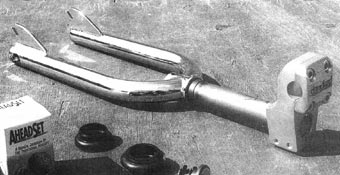
Bicycle Motocross threadless fork and clamp-on stem.
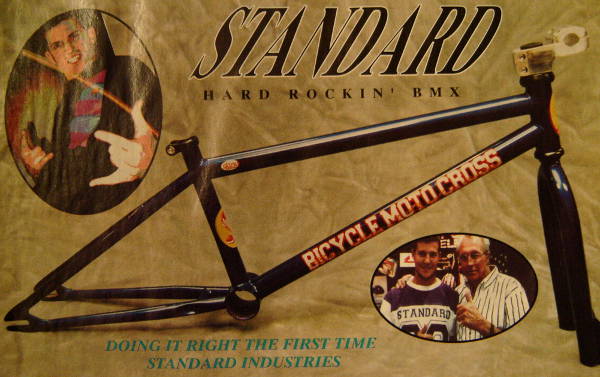
Industrial chain, Masterguard, Knarps, Gyro hood, Seatposts, Unbreak, Shorty and Lenghty, Bicycle Motocross, Stronger Than All, Forks, Coaster shells, Strip bars, Hand Grenades pegs, 4 inch axle pegs, Axles.
HAND GRENADE PEGS.
Rick Moliterno, digbmx.com, may 2012: Hand Grenades… I think these might have been the first big diameter peg (not claiming – I just don’t recall any until these). They were the idea of Chad DeGroot. We have always listened to riders and have been open minded to trying new things.
AHEADSETS.
christhejob, www.radbmx.co.uk, november 2008: In 95 Standard started making ahead shorties and lengthies, (with some laughable tiny "gyro tabs", we had to knock them off with a chisel and file out the gyro bits for under the headset cup) Then when odyssey finally made OS gyros aheadsets became the norm.
STRIP BARS.
Rick Moliterno, www.facebook.com, may 2011: If they give us credit for nothing else, at least know we were the originators of the stupid play or words handle bar names. It was actually written in as a joke, 20 years and still funny, I guess.

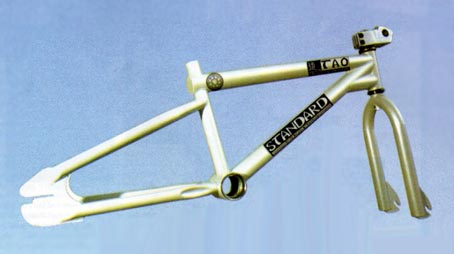
Paul Osicka designed a flatland frame: the Tao.
New head gusset, no platform, raised chainstays for better clearence, 19" top tube; 74.5° head tube, 13.25 chain stay.
Paul Osicka, ad in Ride BMX UK october 1996: The Tao is a way of liberation from the abstractions of the past and the future. The Tao of Ground is a liberation from unnecessary obstructions, gimmicks, useless platforms, and elevated chainstays. Its simplicity leaves only quality to be experienced. Welcome to the truth of flatland.
Krt Schmidt left Standard.
STANDARD TRAIL BOSS.
Robbie Morales, Ride BMX US june 1997: The Trail Boss was basically my idea. I worked together with Rick Moliterno on it. It's basically an STA front end, super beefy, super strong, with the rear end of a Motocross with straight gauge tubing and thicker dropouts, if you want to run a peg. The whole idea was for once to specifically build a bike just for the trails. It's lighter than an STA, and a little heavier than a Motocross. It's just right for dirt jumping. It'll come with a 20" top tube and a 21" top tube, so for short people it'll fit them.
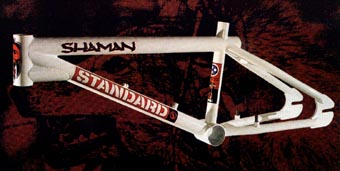
Bobby Fisher designed a frame with the dual purpose of riding flat and street: the Shaman. 19.5" top tube; 74.5° head tube.
FALLOFF.
Brian Tunney, espn.go.com, january 2009: Standard suddenly fell off. Almost overnight, Standard Byke Co. became just another fish in an ever-growing pond. The company was still firing on all cylinders, constructing frames from new metals such as OX Platinum tubing and air-hardended chromoly, and sponsoring new riders such as Brian Kachinsky, but Standard was no longer one of the big three rider-owned companies. At the time, BMX was experiencing a boom in rider-owned companies. In fact, many of Standard's former riders went on to form their own companies after leaving Standard. Joe Rich and Taj Mihelich formed Terrible One. Robbie Morales joined them at T-1 before starting Fit. And Jimmy Levan started Metal soon after riding a Trail Boss frame throughout the legendary Props video, Road Fools 1. Rather than step up, Standard stood back and ultimately fell into obscurity. Standard never officially closed up shop though. They were still there, just quietly kicking back behind the scenes for a few years.
Philbert, www.radbmx.co.uk, november 2008: Generation 3 in 1996 saw two new gussets at the front end, as well as the distinctive wraparound gusset, two plates were added on upper and lower of tubing to give better strength. sadly after this the legendary frame was retired for several years but in 1999 saw the rebirth of the lengthy. completely redesigned with thick sections of dropout, beefy tubing, this was probably arguably standards heaviest and strongest frame built. the platform had gone, was very similar to a STA of the time but sported stepped dropouts. 6mm with 8mm around where the wheelnut goes on. yeilded the best slogan on the frame 'through the flames the image of an old beast appeared in a new world' and its own sticker of the mythical phoenix.
Standard has made a bike (a 16" frame) for kids under 12 called the Starship destroyer.
Philbert, www.radbmx.co.uk, november 2008: A few companies dabbled with kids frames and to order standard devloped the starship destoyer 50. basically a mini STA that took a 16" wheel.
PLATINUM.
Philbert, www.radbmx.co.uk, november 2008: Use of ox platinum air hardened tubing was put into the production S.T.A's, 125, and trls 250.
Luc-E signature frame. Handmade in the USA. Full 4130 Chromoly frame - 990 brake mounts - top tube: 20.5" - chainstay: 14.4" - dropouts: 3/8" - head tube: 1 1/8" 74.5º - seat tube: 71º - seatpost size: 25.4mm.
Philbert, www.radbmx.co.uk, november 2008: In 2001 a 'more affordable' frame was launched under the signature of john (luc-e) engelbert, and was given the name 'cashius'. had open dropouts instead of the distinctive capping and only came in yellow and black.
Rick Moliterno signature frame with double butted OX platinium top (20.5") and down tubes, european bottom bracket
Avril 2003, Eastreet distribution importe la marque Standard pour la France.
www.standardbyke.com, january 2005: It is now 2005 and we have 5 new frames out: the Bullitt, 250S, 250L, 125R, and the Expert. We have a new, lighter stem. We are working on 2 new stems, a race sprocket, new forks, and a new seat post clamp. Also, look for all new softgoods this summer!
125R FRAME.
The new frame is lighter, sleeker, and cleaner. We kept the same great geometry that is great for fast starts, easy manualing, jumping, and cornering. We lightened the head tube, lowered the top tube, seat tube, and seatstays. We also made the dropouts a lot smaller and thinner. I think it is a better overall race frame than the previous model.
CATALOG.
www.standardbyke.com, february 2005: After 3 years of putting it off we finally have a new catalog!
FRONT LOADER STEM.
www.standardbyke.com, march 2005: SBC's prototype Front Loader stem arrived this week. Looks smooth and is quite light. 11 oz. It should be available in mid April!
www.standardbyke.com, august 2006:The 2007 250S, 250L, and 125R have arrived! Better than ever!
rideukbmx.com, august 2007: Standard Bykes have, since the start of the company back in 1991, prided themselves on product quality and attention to detail, and flat-out making rad BMX product. But even so, they never had manufacturing in-house; but that has all changed now. Rick Moliterno, Standard's main man, has just opened up their very own workshop / factory. Here's Rick with more: We are happy to announce the future opening of Standard Byke Manufacturing Inc. This will be an expansion of Standard Byke Company. After 15 successful years as a high quality and innovative BMX company- we have decided to expand into manufacturing our own goods. In the name of customer service, supply, warranty, and product development we have decided to build everything, ourselves, in house. We are motivated to make this move to improve on some weaknesses that have developed over the past 5 years. When we set out 15 years ago to build better bikes, we planned on making the best possible product as demanded by riders that want the best. We have fulfilled this for 15 years. We plan to improve our customer service and supply by stocking the products we make. What rider or shop wants to wait 8 weeks for a frame? We plan to improve on our warranty process. We don’t think a rider should wait several weeks while their claim is "looked at". We will aggressively pursue new product development. We feel riding demands are constantly changing and our products should progress along with those needs. This is a truly exciting time for all of us here at Standard. We are excited to fine-tune our company to match the vision for the future we all share. Look for a better, stronger, and faster Standard beginning late this fall!
Rick Moliterno, digbmx.com, may 2012: I have always wanted to build bikes with my own hands so here we are doing it. This year marks 5 years of doing that. I always designed the stuff and then had it made in Wisconsin for 16 years. It has been an awesome learning experience to build them with my own hands. We are open to new ideas, customs, all kinds of styles of bikes, and new ways to improve on our high quality standards. We have been doing small runs for start up companies as well. I remember what it was like trying to get our first prototypes made and then trying to find a manufacturer that could deliver. I want to help make that easier for others that have ideas as well as continue with our own line of frames, forks, bars, and parts.
Patrick Nugent, espn.go.com, january 2009: After moving manufacturing in-house, Standard is back, and seemingly, as strong as ever in the race scene. You can't turn your head at a BMX race without seeing someone riding an 125R, or wearing a Standard t-shirt, or reppin' a jersey that adorns a Standard logo. It's like the second coming, Y2K all over again. Standard is everywhere. And Rick Moliterno, the same Standard owner featured in Dave Mirra Freestyle BMX 2, is still here. 45 years young and still pushing, still traveling to races and of course still heckling.
Jerry Bagley .... - december 1998
Brennan Brown
Sandy Carson 1995 - 1998
Mel Cody march 1994, Standard picked up Mel Cody who used to ride for HB - ....
Chad Degroot 1993 - summer 1997
Phil Dolan march 1994 Phil is now riding for Standard with KHE components.
John luc-e Englebert 1994 - pro model 2001: the Cashius - ....
Bobby Fisher 1994 - .... pro model 1998: Shaman
Dave Freimuth .... - summer 1997
Mark the gonz Gonzales december 1998 - ....
Chase Gouin october 1992 Chase is leaving Homeless (in good terms) for Standard. Apparently the lure of cash was too hard to resist. - spring 1993
Chris Hallman end of 1994 - ....
Tom Haugen In 1991, Standard had just begun and I was friends with the owners. They gave me everything they made at that time and that was my first sponsor.
Mark Hilson march 1994 - ....
Brian Kachinsky
Ron Kimler 1995 - summer 1997
Jimmy Levan 1998 - ....
Corey Martinez Just before the Roots Jam 2000, Rick Moliterno asked me if I'd like to ride for him. - ....
Trevor Meyer 1992 - 1994
Taj Mihelich 1993
Rick Moliterno
Robbie Morales summer 1993 - 1998
Ian Morris spring 1993 - ....
Lee Musselwhite may 2003 - ....
Mark Murphy 1992
Bill Nitschke and then found Indy Industries.
Paul Osicka march 1994 - ....
Kevin Porter .... - october 2002
Jesse Puente 1993
Brandon punjab Pundai 1999 - autumn 2001
Joe Rich 1993 - summer 1997
Ratboy
Jim Rienstra 1999
Chris Rye march 1994
Krt Schmidt 1991 - 1997 then 2001 - ....
Jeremy Verhulst
Brian Vowell november 2001 - ....
Dylan Worsley may 1994 - ....
John ratboy Wrigley
Chris Young 1994