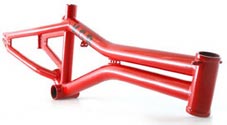
Borrowing on the design of the Torker frame, Haro introduced the first strictly made for freestyle frame in 1982.
BMX Action october 1982: Haro Freestyler frame designed by Bob Haro. The reinforced chrome-moly frame features double tube construction, heavy duty rear dropouts with a built-in coaster brake mounting slot. All chrome-moly. Haro Designs.
Bob Haro: I used to ride for Torker. They were one of my sponsors. Haro Design, as the company was called back then, was growing. We were making different things. Freestyle was a novelty back then and I thought it was time to create a Freestyle only bike, instead of a BMX racing bike used for freestyle... I basically had a Torker BMX bike and I asked them to modify it to a bike for freestyle riding. It needed thicker drop-outs, a steeper head angle and the double top tube made sense for the type of riding at that time. I had a good relationship with the guys at Torker at the time and I basically went in one day and told him I wanted to have my own frame and my own brand. I think I told them I could either do it with, or without you, and then they worked with me. We ordered really small numbers at the time because it was so novel. Torker gave me a big start, they really helped out. They had the fixtures and things like that. We bought the frames of my design from them, put our graphics on them and sold them. It was very expensive at the time because the numbers were very small but that got us started. That was the beginning.
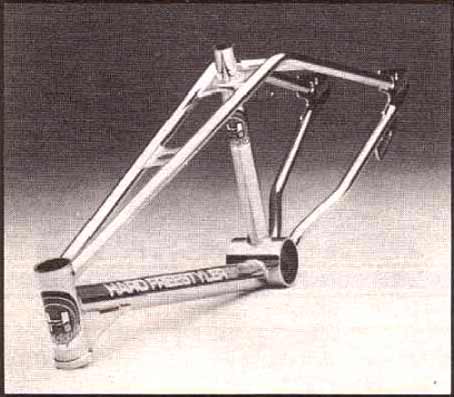
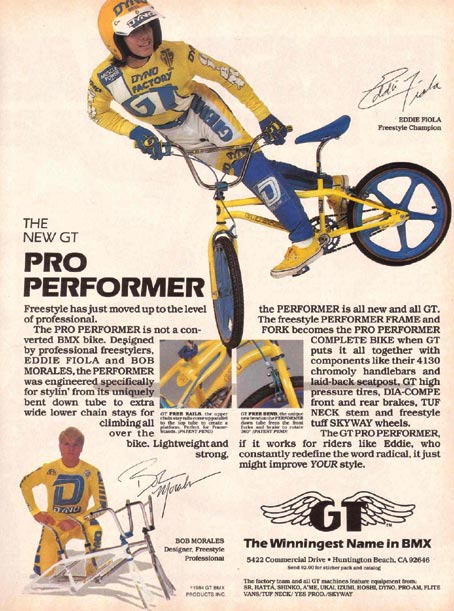
Bob Morales and Eddie Fiola designed the first GT freestyle frame and named it the GT Performer.
Ils jetent ainsi les bases d'une nouvelle géométrie qui sera reprise (copiée ?) par la plupart des constructeurs. A l'époque, les principales révolutions concernent le cintrage du tube inférieur au niveau du tube de direction et la plateforme rabaissée.
The bend at the top of the downtube was to enable full 180° x-up without crushing the front brake cable (this was before Potts Mod cable routing)
Ron Wilkerson: GT was coming out with a freestyle frame and we were TOTALLY stoked because that was a BIG thing - another company besides Haro making a freestyle bike.
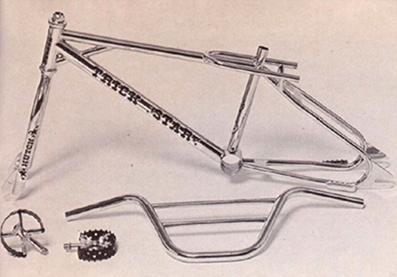
Woody Itson designed the Hutch Trick Star.
With the advent of dirt jumping in the late '80s, Chris "Mad Dog" Moeller designed a heavy duty race frame that could withstand the demands of racing and jumping. Moeller took aspects of other frames he rode, combined them and had two frame sets made. Demand grew for more and that original frame morphed into his signature Mad Dog.
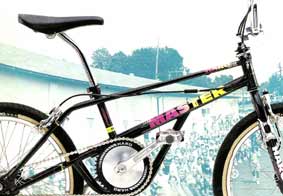
The Haro Master 1989 is sporting a bash guard.
In 1989, Ron Wilkerson walked away from a deal with Haro and started his own brand, Wilkerson Airlines. Their first frame, the Riot, was a massively overbuilt BMX frame. "We basically used the same geometry of the Haro Sport and made a US-made beefed-up version," said Wilkerson. The Riot helped to usher in the first wave of overbuilt BMX frames.
In 1991, Mongoose signed Dennis McCoy to their team and released his signature bike, the Hooligan. The Hooligan was one of the first frames from the larger BMX manufacturers to address the needs for a stronger BMX frame at the time, utilizing thicker diameter tubing and an ovalized down tube for added strength.
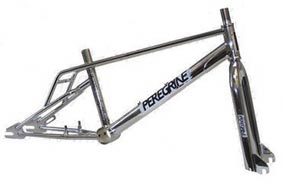
In 1992, Kevin Jones is working with Peregrine on the manufacture of a Plywood Hoods freestyle frameset.
Peregrine frame and forks weighs 6 pounds 1 oz made from 4130 chromoly tubbing, drop outs are 3/8 inch has 1 inch gusseted headtube twin top tubes 990 rear brake mounts
Standard Industries introduces the Lengthy and Shorty frame. These frames have thicker dropouts and are much stronger than any bike in the market.
First introduced in 1992, the HB Condor was the frame of choice for Mat Hoffman, Jay Miron, Dave Mirra and countless others. The Condor's strength and modern geometry helped to push the boundaries of what was possible on a BMX bike, and countless acts of progression have been documented on the many Condor frames sold since its introduction.
Designed by Kevin Jones and built by Hoffman Bikes in Oklahoma City, the Big Daddy frame was HB's first frame devoted to flatland. Shorter and more responsive than the Condor, with a built-in frame platform, the Big Daddy was responsible for the progression of Jones' modern day flatland riding throughout the '90s, as seen in the Dorkin' In York video series.
In 1995, Taj Mihelich designed a dirt-friendly frame for Hoffman Bikes dubbed the Taj. "The Taj frame represented everything I wanted. We got the geometry right and we made it strong. That was all that mattered, something that wasn't going to break," says Mihelich. Because of Mihelich's simplified approach to bike setups and stylish airs, the frame's popularity soared.
Paul Osicka's Standard Tao frame was the first flatland-designed frame to forgo a standing platform, and its simplistic approach created a revolution in flatland frame design. "The Tao of Ground is a liberation from unnecessary obstructions, gimmicks, useless platforms, and elevated chainstays," read an ad for the Tao upon its release in 1996.
S&M Bikes released the Warpig in 1997 as a signature frame for all-around team rider Troy McMurray. Troy originally rode a flatland-inspired S&M frame known as the Sabbath, but switched to a longer version without a platform. The Warpig helped to inspire the first wave of brakeless street riding, and was responsible for the introduction of the tailwhip bunnyhop into street riding.
Standard's Trail Boss, developed by Robbie Morales, was one of the first BMX frames to bridge the gap between the overbuilt period of the early '90s and a more refined, trail-friendly approach to bike technology in the later '90s. "It's basically an STA front end, with the rear end of a race frame, with straight gauge tubing and thicker dropouts," said Morales in 1997.
6061-T6 Aluminum is introduced to freestyle by the groundbreaking GT Show flatland frame. With close input from legendary flatlander Ruben Castillo, Robert Kahler and Jeff Soucek designed a frame specifically for the discipline of flatland.
Rueben Castillo, Ride BMX US february 1998: It's basically a thought that came to my head when I started flatland to get a small lightweight bike. Smaller than any other flatland bike, I'm only 5'3" and a half. Most bike geometry's are made for someone around 5'10 or a 6 footer. I helped with Woody Itson and some of the people at GT. We came up with a bike that has an 18" top tube and a 13" rear end. It's something that has never be done before. We all put our heads together and came up with something that we are really happy about.
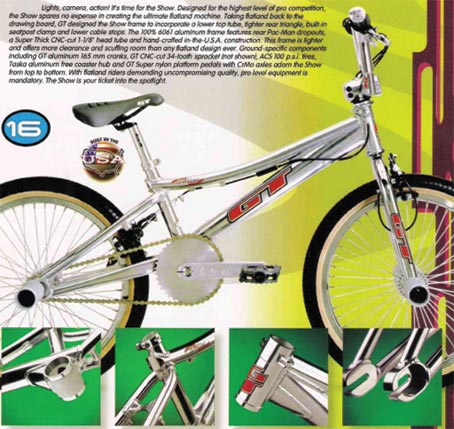
18.75" top tube - 74° steering angle - 13" rear stay - weight under 5.75 lbs - full cro-mo - bent down tube allows maximum clearence where needed on front wheel tricks - lowered seat-stays allow for maximum clearence during back wheel tricks
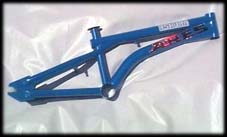
www.agoride.com, 2001: Conçu et testé par Vincent Vernet et Vincent Poupinot, le Cinquième élément est un cadre de street/trail.
Des innovations et des renforts multiples sont présents sur ce premier cadre de la marque: Plaque de renfort sur les haubans inférieurs, tube de direction usiné dans la masse avec cuvettes et roulements scellés intégrés, wishbone inférieur ovalisé et d'autres choses encore
Released in 2001 by MacNeil, Ruben Alcantara's first signature frame with the Canadian-based brand is said to be one of the best selling signature BMX frames of all time. Weighing in just over six pounds, Alcantara's frame was among the first modern BMX frames to equally address the need for strength while keeping the weight down.
"There are plenty of ways to describe Mike Tag -- one of them is straight forward and that came through in Mike's set up. His original pro model frame, the Night Train, was introduced in 2001. It was a simple step forward in a time when frames were over thought," says FBM. After Tag's death in April 2012, the Night Train was reintroduced.
www.expn.com, january 2013: In 2002, S&M Bikes began experimenting with Campagnolo Hidden headsets, which sat completely on the interior of the headtube. After adding Matt Beringer to the team, S&M worked with Beringer on a Hiddenset friendly frame design which ultimately ushered in the universal switch to integrated headsets in BMX frames. The days of the headset cup are now long gone.
2,55 kg, Top tube: 19", Angle direction: 73.5°, Longueur arrière: 12.8", Matériau: 4130 cr-mo, Pédalier: euro ou classique, Made in: Taiwan.